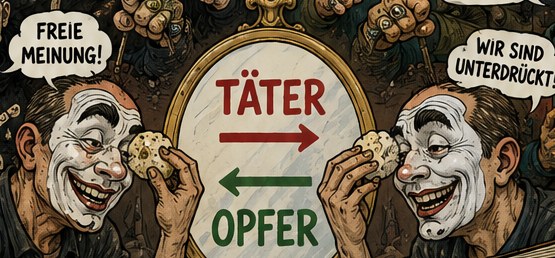
It feels as though something old is coming back. Not in the same uniform, not with the same slogans. But as a tone. As a posture. As an appetite for harshness and a delight in having enemies. The old poison is not suddenly back — it never entirely left. It has only changed its clothes. This text tries to describe those new clothes: nine patterns that prop each other up, from the pub table to the data centre.
The background noise
During the pandemic the madness had an object. Today it has none — and that is precisely what makes it more dangerous.
During Covid, radicalisation was visible. It had a trigger and a target: masks, vaccines, lockdowns, the government, virologists, the press. You could see the demonstrations, name the Telegram groups, recognise the slogans. It was ugly, but in its ugliness relatively clear.
Today it is different. Radicalisation is less spectacular but runs deeper. It no longer has a single trigger. It has become background noise. The hatred needs no pandemic. The enemy images run without a state of emergency. The grievance is no longer tied to events; it is permanent.
Covid was the accelerant. The years since are the embers under the floor. Many people learned during the pandemic that maximum distrust earns attention. Others learned that radical stories create community. Still others saw institutions make mistakes, react slowly, communicate inconsistently. The trust damaged then has not automatically returned — the energy simply moves on. When there is no mask left, the flag matters more. When no vaccine mandate looms, migration becomes the substitute subject. When the state of emergency ends, the inner state of emergency remains.
Society no longer merely seems agitated. It seems irritable, exhausted, suspicious, and receptive to any story that promises relief. Frustration becomes opinion. Opinion becomes identity. Identity becomes camp. Camp becomes enemy.
Not 1933 — but the same procedures
Anyone looking only for swastikas misses the mechanism. History rarely repeats itself as a copy. It repeats itself as a procedure.
The honest answer to the question of whether we are living through another pre-Nazi era is no. Anyone claiming otherwise is making it too easy for themselves. Austria today is a consolidated republic — embedded in the European Union, in constitutional government, in international conventions, in a plural press and a political culture entirely unlike that of the First Republic. But the all-clear would be equally wrong.
What preceded Austrofascism and National Socialism was not only ideology. It was crises, grievances, fear of decline, weak institutions, political violence, distrust of parliaments, and the search for someone to blame. Democracy was not abolished in a day. It was first despised, then hollowed out, then replaced.
Here one has to stay historically precise. Austrofascism was not National Socialism. The Dollfuss-Schuschnigg regime was Catholic-conservative, corporatist, anti-Marxist and authoritarian; it also fought the Austrian Nazis. But it destroyed parliamentary democracy, weakened civil liberties and crushed the labour movement. That is exactly the point: movements that sell themselves as a bulwark against a greater evil can themselves become anti-democratic.
The parallels to the interwar years lie not in the costume but in five procedures.
- The crisis is personalised. Inflation, housing shortages, migration, failing schools, globalisation — complex problems are reduced to enemy groups. Then it was „Marxists“, Jews, liberals, „the system parties“. Now, depending on the camp: migrants, believers of whichever religion is the other one, „the elites“, „Brussels“, journalists, feminists, minorities of every kind — or simply „the others“. Which group gets the role is interchangeable. That one gets it is the point.
- The people are played off against the institutions. Authoritarian politics claims to represent the true will of the people against parliaments, courts, science and administration. But those institutions are not decoration. They are the brakes meant to stop an inflamed majority from becoming a weapon against minorities.
- Symbols replace arguments. Flags, colours, slogans, marches, historical myths, cults of victimhood and fantasies of purity supply identity without thought. Someone who feels weak can feel strong by dissolving into the collective.
- Violence is prepared before it is committed. First comes the language. Then the disinhibition. Then the threat. Then the group. Then the act. The boundary between pub table, chat group, street appearance and assault is more fluid today than it once was, because digital spaces accelerate radicalisation.
- Respectable normalisation opens the door. Fascism rarely marches to power alone. It is underestimated, co-opted, or used tactically. In the interwar years that proved fatal. It is a real danger again whenever democratic parties adopt authoritarian language because they believe it will win voters back.
In this picture the Freedom Party is not merely a protest party. It carries a political style that combines national homogeneity, anti-migration politics, hostility to the press, contempt for elites and a longing for authority. Its success reveals not only dissatisfaction but also the willingness of many people to rate simple answers above liberal democratic safeguards. That does not mean every voter is an extremist — that generalisation would be analytically false. But the danger lies precisely there: authoritarian movements do not need only committed ideologues. The cadres supply the ideology; the disappointed supply the legitimacy.
The grievance society
The central raw material of the present is not hatred. It is grievance — and grievance can be politically refined.
Grievance does not simply mean that someone has been insulted. It is the sense of having been devalued, passed over, made ridiculous, cheated. It is the wound of a person who believes: the world owes me something, but it is giving it to others.
Grievance does not automatically produce extremism. But political entrepreneurs can refine it. They say: you have not failed, you have been betrayed. You are not unsettled, your country has been taken from you. You need not think, you need to defend yourself. You are not alone, you are part of a people.
That this offer works right now has reasons that overlap. Economic insecurity: housing costs more, work feels less secure, advancement is less credible for many. Someone under permanent pressure becomes more susceptible to simple answers — not because they are stupid, but because chronic stress narrows thinking. Loss of representation: people hear transformation, climate neutrality, competitiveness, integration — and simultaneously experience rising prices, overwhelmed schools, and a political language that sounds like administration without a pulse. Cultural overload: migration, gender roles, religion, urban change, war, climate and digitisation are altering everyday worlds faster than many can process them psychologically. Permanent digital agitation: radicalisation once required a club, a pub table, a newspaper, a preacher or a street. Now a phone suffices. The algorithm delivers each person their tailored grievance by the minute. Institutional distrust: where people believe that politics, media and experts serve only themselves, a vacuum forms — and it is not filled neutrally. And social isolation: many are formally connected and practically alone. Where real community is missing, substitute community becomes attractive. Fanaticism is often a misused longing to belong.
The craving is not for truth. It is for relief.
Nationalism converts private insecurity into collective strength. The cult of the leader converts doubt into obedience. Conspiracy belief converts complexity into intent. Religion, politically misused, can convert ambivalence into absolute certainty. The individual no longer has to ask: what is true? What is my share in this? What must I learn? They need only ask: who is one of us, and who is against us?
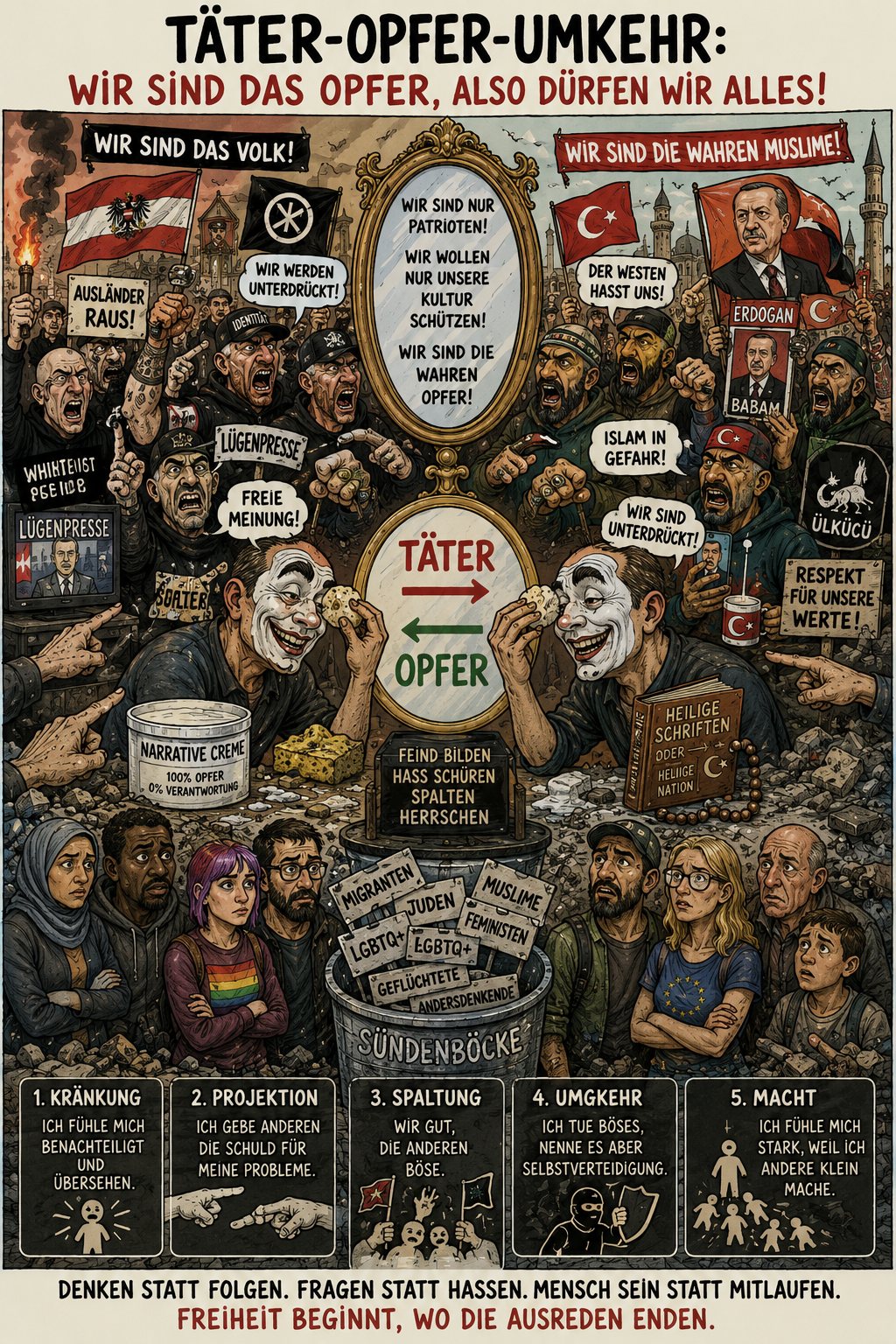
Perpetrator-victim inversion
The attacker appears as the defender. This is no side issue but the most important psychological engine of authoritarian movements.
The principle is simple: whoever devalues, threatens or excludes others declares themselves the real victim. The agitator calls himself a fighter for truth. The intimidator speaks of free speech. The nationalist claims he only wants to protect his culture. The religious hardliner is only defending his community against decay. Aggression is thereby morally laundered: one's own hatred no longer appears as hatred but as self-defence.
Powerlessness becomes attack
At the beginning there is usually a grievance. The world is experienced as humiliating, unmanageable, unjust. That powerlessness is hard to bear — the inversion solves the problem by reversing the sign.
From„I am afraid“
comes„We are under threat“
From„I feel unsettled“
comes„They want to annihilate us“
From„I can't cope with the world“
comes„They are destroying our country“
This makes one's own aggressive behaviour subjectively permissible. Someone who experiences himself as a victim need no longer ask whether he is being unfair, brutal, racist, antisemitic or misogynistic. He believes he is merely reacting.
Projection and splitting
A second mechanism follows: whatever one refuses to see in oneself is attributed to the opponent. One's own aggression becomes the aggression of others. One's own wish for control becomes the alleged control exercised by „the system“. One's own longing for conformity is sold as a fight against „re-education“. The far right speaks of a „dictatorship of opinion“ while intimidating opponents. Fundamentalists speak of „discrimination“ while seeking to control women and dissenters. Conspiracy ideologues insist they are only asking questions, while supplying finished enemies.
Then comes the splitting: our group is honest, natural, hard-working, rooted; theirs is corrupt, parasitic, decadent, treacherous. The relief is enormous. Ambivalence disappears. One no longer has to differentiate, only to sort. That is not thinking. That is psychic simplification.
The moral licence
Out of all this comes a permission. Dehumanisation is then called „plain speaking“. Exclusion is called „self-protection“. Demands for censorship are called „protecting the truth“. Fantasies of violence are called „self-defence“. The cult of the leader is called „respect“. The unspoken sentence runs: because we are victims, we may be perpetrators. That is the tipping point from resentment into political danger.
So one must distinguish cleanly, and in both directions. Real victims exist: people attacked because of their skin colour; women who suffer violence; believers threatened or collectively suspected because of their religion; minorities excluded by the majority; dissenters intimidated from inside their own community. Real victimhood deserves protection, rights and recognition. The authoritarian pose of victimhood is something else: it borrows the language of suffering to disguise a claim to dominance.
Real victims demand rights. Authoritarian victim poses demand submission
„It was Kevin“
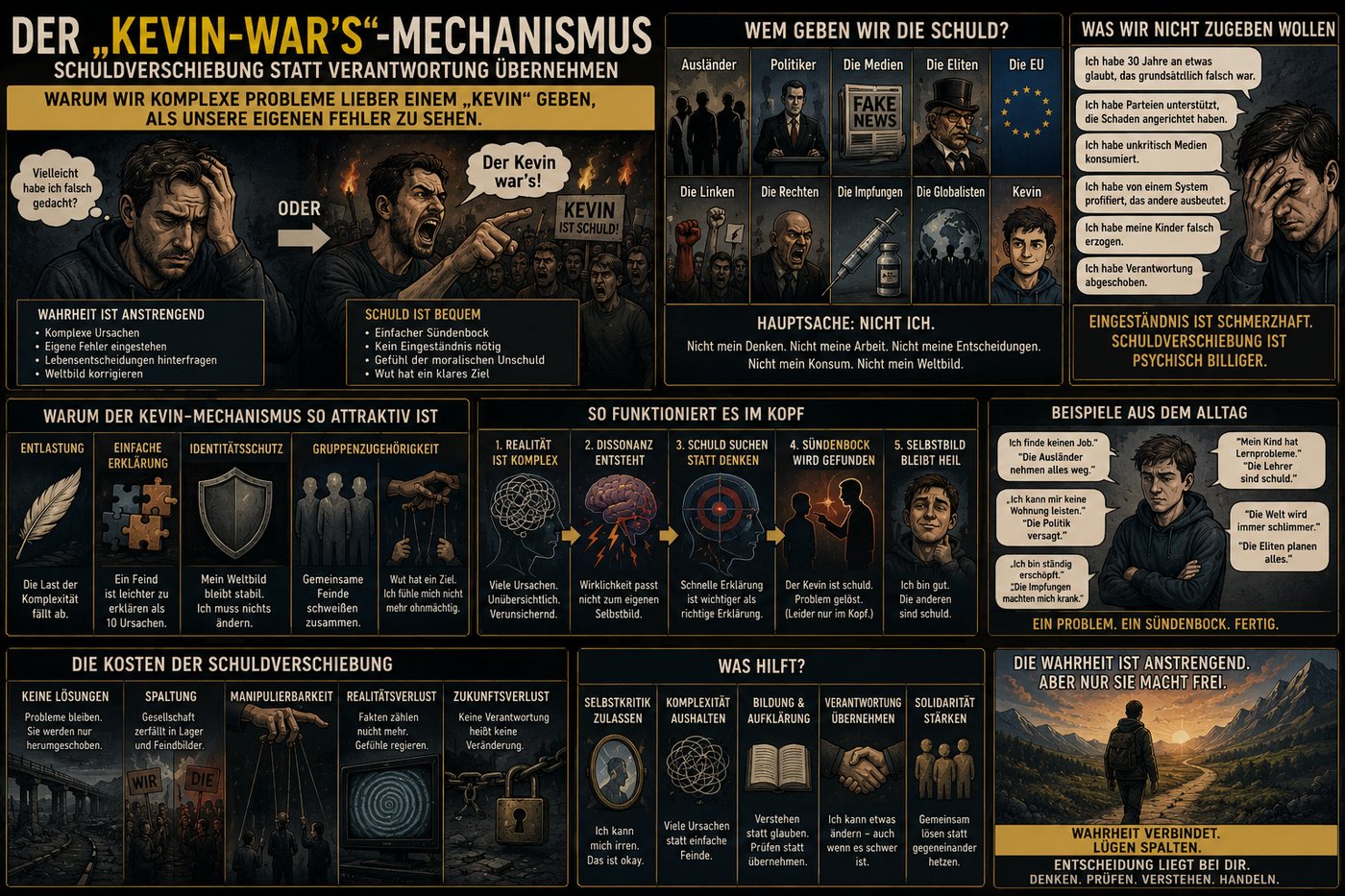
Why people would rather find someone to blame than find causes — and why the admission would cost too much.
Of course this is not about Kevin. Kevin is a placeholder — for anyone else, for the convenient figure onto whom everything can be unloaded that one refuses to examine in one's own thinking, one's own milieu, one's own way of life.
Complex causes are hard to bear. Housing shortages have to do with land policy, speculation, wages, construction costs, interest rates, planning and ownership structures. Educational failure has to do with social background, language, resources, teacher shortages, segregation. The climate crisis has to do with energy, industry, consumption, transport and decades of avoidance. All of that demands thought. The scapegoat, by contrast, relieves immediately. It has a face and a name. It turns structure into drama and analysis into feeling.
Behind this lies a second, harder reason. Many people cling to false convictions not because they never doubt, but because the admission would cost too much. Someone who has believed a political story for thirty years does not easily say: I spent half my life on a false assumption. Someone who staked his life on toughness, obedience and conformity finds it hard to accept that precisely those virtues did not save him. Then it is psychologically cheaper to find a Kevin. Because if Kevin is to blame, I do not have to rebuild my worldview.
Esotericism and conspiracy belief: the same function
Esotericism often looks harmless, soft, peaceable. But it can perform the same function as authoritarian ideology: it reduces complexity and supplies meaning without examination. Illness becomes a „blockage“; political crises become the plan of dark forces. Coincidence becomes a sign, complexity becomes intent, feeling becomes truth, suspicion becomes insight. Not every spiritual practice is dangerous. But where examination is replaced by feeling, the problem begins.
Conspiracy theory is the more radical form. It says: nothing is coincidence, nothing is structure, everything is planned. That is comfortable, because it turns disorder into order. A planned enemy is psychologically easier to bear than a complex reality with no centre. Whoever believes in a conspiracy need no longer ask why systems work as they do. They need only ask who allegedly controls them.
Not:Why does the housing market produce inequality?
But:Who wants to drive us out?
Not:Why does AI make work less secure?
But:Who is planning our total enslavement?
Not:Why am I afraid?
But:Who is threatening me?
Resentment is thereby laundered: hatred puts on the mask of insight. One does not say „I hate“, one says „I am defending myself“. One does not say „I don't want to learn“, one says „I refuse to be re-educated“. One does not say „I am afraid of complexity“, one says „I see through the system“.
The formula behind it: the greater the fear that one's own life, thinking or milieu was built on false assumptions, the stronger the urge to find an external culprit. A mature society would say: we must reorder institutions, property relations, working life, education and social security. An immature society says: it was Kevin. And the next demagogue need only point out who Kevin is.
The city of flags
Vienna is not an ethnic backdrop but a republic in miniature. What shows here is not a problem of origin — it is a blueprint that works anywhere.
Municipal housing blocks, the Gürtel ring road, a mosque, a duelling-fraternity house, the Chamber of Labour, a coffee house, a Balkan restaurant, a Turkish supermarket, a Ukrainian aid initiative, a Kurdish demonstration, a left-wing centre, Catholic tradition, a secular middle class: Vienna is where one can test whether a society stays pluralist or falls apart into competing tribal logics.
The problem is not origin. A free city must tolerate that people bring memory, language, religion and family history with them. It becomes a problem where origin hardens politically: where culture turns into loyalty, flags into territorial markings, religion into a claim to rule, history into a myth of victimhood. Then what is visible is no longer diversity. What is visible is power.
Not one nationalism, but a blueprint
The mistake in many debates is to see only one — and then to argue about origin instead of structure. Some see only native far-right extremism, others only „imported“ nationalism. Both views are too narrow, because both miss the decisive thing: there is no Turkish, no German, no Serbian, no Russian special path into authoritarian loyalty. There is a blueprint, and it works in every language.
It always has the same parts. A community of descent or of faith that stands above the individual. A history in which one's own group was always the victim and never the perpetrator. An enemy to be found both inside and outside. A leader figure who takes doubt away. And symbols that carry all of it without a single sentence. The individual is relieved of himself by dissolving into the group: the group supplies identity, the flag supplies pride, the history supplies justification, the enemy supplies direction, the leader supplies truth.
The difference lies in the myth, the similarity in the mechanics. So the question is never: which country does this come from? It is: is belonging being defined by descent? Are dissenters being declared traitors? Is a ruler being venerated rather than criticised? Is territory being marked rather than inhabited? Anyone asking those questions honestly will find hits in every milieu of a large city — long-established as readily as newly arrived, secular as readily as religious. Anyone searching in only one direction is not doing analysis but factional politics.
Not the religion, but the claim to rule
The same holds for faith, and here precision matters most, because here generalisation comes fastest. A prayer, a house of worship, a holiday, a head covering, religious upbringing: that is the practice of religion, not extremism. Confusing the two is a culture war, not a defence of democracy.
Fundamentalism is something else — and it exists in every religion. It does not seek to explain how the individual should live, but how society, law, the relations between the sexes and public order must look. Christian movements that would rebuild the law around their doctrine of salvation. Hindu nationalism that ties citizenship to religion. Buddhist nationalism that declares minorities foreign bodies. Jewish, Islamic, Orthodox fundamentalism, each with the same core. They fight one another — and use the same grammar.
The structural parallel to völkisch thinking is obvious. One says: the people stand above the individual. The other says: the divine order stands above the individual. Both distrust the open society, both need dissenters as enemies, both declare doubt to be treason. One can be devout and a democrat. One cannot be a democrat and simultaneously demand that one's own truth apply to everyone.
„They're only symbols“
Symbols are never „only“ symbols. Flags, gestures, badges and portraits of leaders are social signals: I belong. I know who we are. I know who does not belong.
Of course not every flag is dangerous. A flag at a football match, on a national holiday or at a cultural event is not the same as the permanent political marking of a shop, a clubhouse or a street. Context, accumulation, message and milieu all matter. The line runs where symbols stop being expression and start claiming territory: „our order applies here“.
And one can watch how cosily it arrives: leaders' faces on posters, dictator kitsch in souvenir shops, nationalist rings, walls of flags, martyr pictures, political tattoos. Sometimes it looks almost ridiculous — and that is exactly where the danger lies. Kitsch makes the authoritarian comfortable. Dictatorship becomes a souvenir, the cult of the leader an accessory, ideology a lifestyle.
One more thing is striking: these movements supposedly despise globalism and are themselves global through and through. One grows up here, goes to school here, and venerates a strongman who governs a thousand kilometres away. Another grows up two districts over, shares memes from American forums, believes propaganda from Moscow, and considers himself a defender of the West. Both believe they are fighting globalism. Both are products of global digital milieus — and both have more in common with each other than they would care to admit.
Vienna must therefore avoid two mistakes. Naive folklore, which waves away political intimidation as colourful diversity. And crude blanket suspicion, which declares every flag, every shop and every family a problem — that drives people into protective communities all the faster. The sober standard runs: the problem is not origin but authoritarian loyalty. Not religion but the political claim to rule. Not the flag but the message beneath it.
The city does not belong to the flags. It belongs to its citizens. And citizens are not followers
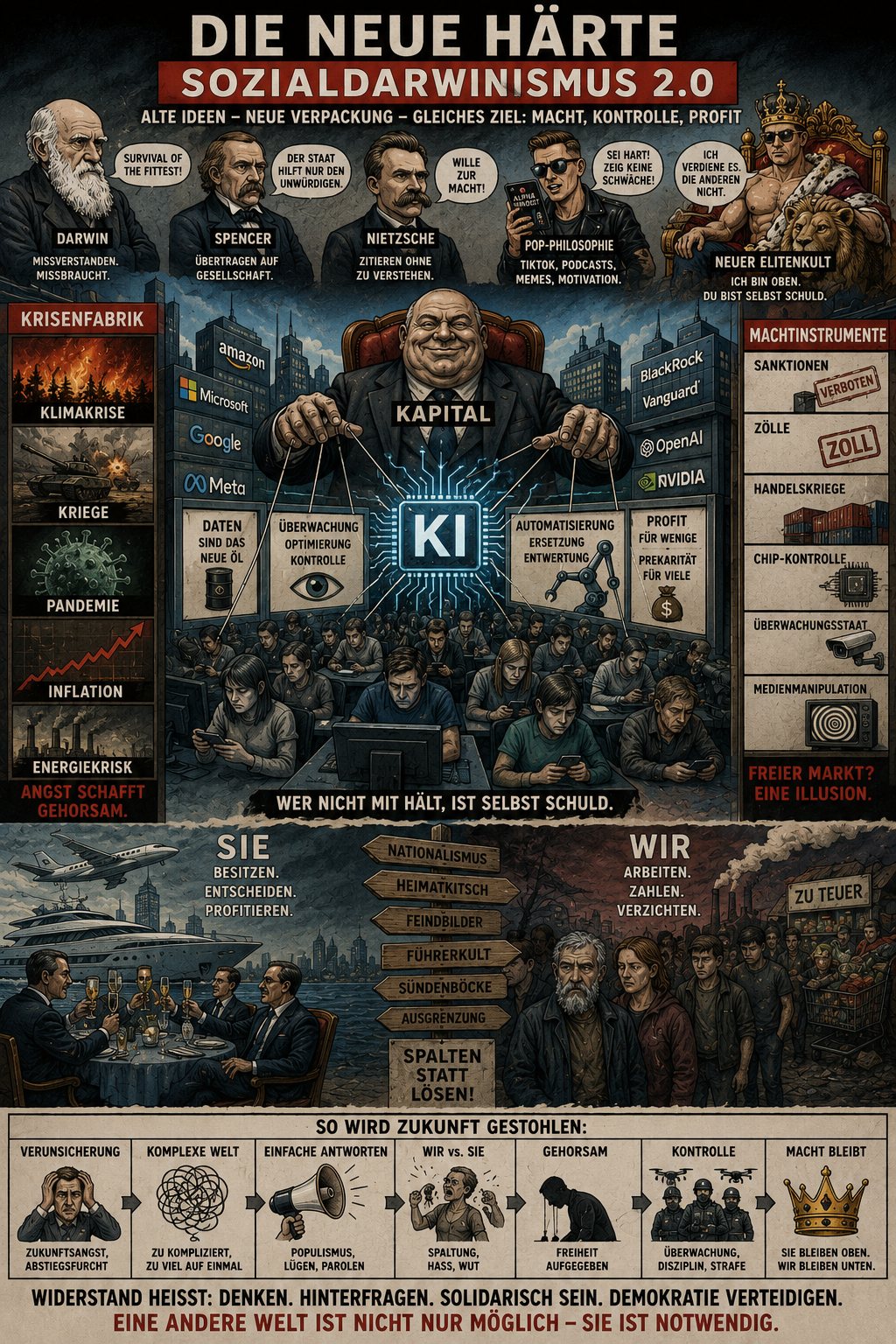
The new harshness
Beneath the flags, the leader cults and the homeland rhetoric lies a deeper layer: the return of social Darwinism — in new language.
It says: whoever goes under was too weak. Whoever stays poor failed to adapt. Whoever loses their job was not flexible enough. Whoever is ill, old, exhausted or overwhelmed becomes a cost factor. Whoever is at the top counts as capable; whoever is at the bottom counts as the author of their own misfortune.
It used to be called the survival of the fittest. Now it is called resilience, performance, personal responsibility, adaptability, competitiveness, efficiency, the logic of the business location. The message stays much the same: the market sorts, technology accelerates, and the state should above all protect those who are useful.
This attitude rarely arrives as an open confession. It arrives through pop culture: as a meme, a podcast line, a fitness aesthetic, „alpha“ talk, Spartan kitsch, Viking fantasy, endless talk of decadence and softness and natural hierarchy. Thinkers are used like branded goods: Nietzsche reduced to the will to power, Darwin abused to justify social ruthlessness, Stoicism treated not as a school of self-command but as a cold pose of hardness. That is not education. It is intellectual merchandising: one does not read in order to understand, one grabs concepts in order to feel stronger.
Renaming as trivialisation
The present has an enormous capacity for renaming ugly things.
Exploitationbecomes flexibilisation
Surveillancebecomes security architecture
Welfare cutsbecome reform
Job lossesbecome transformation
Social Darwinismbecomes meritocracy
The language is cleaned so that the power can stay dirty. That is precisely where the danger lies: societies are changed not only by violence but by vocabulary. Whoever controls the words controls the boundaries of the thinkable. Once people read their own decline as personal incapacity rather than as a structural problem, political resistance is already weakened.
AI is not just a tool, it is a question of ownership
Artificial intelligence is not automatically evil. It can help, heal, translate, sort, analyse, research. But the decisive question is not what AI can do. It is: who owns it? Who controls the data, the data centres, the chips, the models, the interfaces, the access?
Under current ownership arrangements, AI is above all an instrument of power for those who own the infrastructure. The individual user does not own the machine. They rent access, supply data, indirectly train systems — and become measurable, assessable, replaceable. For companies, AI is therefore not only a tool but also an instrument of discipline: it can accelerate work and devalue it, extract knowledge from employees, cut junior positions, industrialise creative labour. The new sentence is no longer: work faster. It is: work faster than the machine, with the machine, for the machine.
A new division emerges: at the top those who own AI or deploy it strategically; in the middle those who become more productive with AI but more closely monitored; at the bottom those whose work is devalued, automated or made precarious. This is not neutral progress but a question of distribution. If productivity rises while profits are privatised, the result is not progress for all but a rentier economy: the machine works, the owner collects, and the employee is told to retrain.
The free market applies to the weak
In the official story the market is a neutral order: supply, demand, competition, innovation. But the moment strategic technology is at stake, the folklore ends. Then come export controls, sanctions, tariffs, investment screening, subsidies, chip acts, industrial policy, supply-chain policy. Semiconductors make this especially clear: chips are no longer merely goods, they are instruments of power. Suddenly what counts is not efficiency but control. That is not a malfunction of the system. That is the system once things get serious.
Trade wars, sanctions and tariffs belong to the same context. For decades globalisation was sold as an inevitability. Now it is apparent that this order was never apolitical; it was always protected by power. Energy, chips, rare earths, data, medicines, grain, ports, cables — everything becomes strategic. Economics is never only economics. It is power in condensed form.
Wars accelerate this logic further. They generate insecurity, inflation, armament logic, enemy images, pressure to be loyal. In wartime, differentiation becomes suspect: whoever asks is quickly a traitor, whoever doubts is weak. This does not mean there are no aggressors, and not that sanctions or military support are always wrong. But one must see what the logic of war does socially: it normalises harshness and makes authoritarianism more plausible. People living permanently in a state of emergency get used to emergency instruments.
Here the circle closes back to nationalism. In this system it is not a foreign body but the emotional glue. It translates abstract systemic crises into simple pictures. Not: capital, technology, ownership, geopolitics and ecological crisis are generating pressure. But: the foreigners are to blame. The enemy image makes the complex crisis consumable.
The deepest engine is not hatred. It is the fear of being superfluous
That fear is real: losing the job, sliding down the social ladder, being technically overtaken, watching one's children live worse, finding that education, work and discipline are no longer enough. But it is politically poisoned. Instead of saying we need new rules of ownership, social security, education, democratic control of technology and fair distribution, authoritarian populism says: find yourself an enemy. That is the swindle. People have real reasons to be angry — and they are given false targets.
The new substitute religions
The present is not without faith. It merely believes differently — and the modern opium has not disappeared, it has multiplied.
It no longer believes collectively in the church, the nation or progress in the old sense. But it still seeks redemption, comfort, order, healing and belonging. That is where the new substitute religions arise: technology, AI, markets, security, longevity, psychedelics, pop culture, body optimisation, nature kitsch, national myths.
Technocracy speaks not of God but of data, efficiency, evidence, transformation. Its message: there is no alternative. That sounds rational but conceals power. Every technical solution contains interests: who measures? What is measured? Who profits from efficiency? Who gets cut? Technocracy hides politics behind method. Rule no longer appears as rule but as process.
AI becomes an oracle. One asks, and something answers. That is practical, but it changes the relationship to one's own judgement. The dangerous shift runs: no longer „what do I think?“ but „what does the system say?“; no longer „who bears responsibility?“ but „the algorithm decided“. A new fatalism emerges. Once people said: God wills it. Now they say: the data show it.
Pop culture is not mere entertainment; it produces worldviews. Series, games, blockbusters, sporting events, influencers and political clips supply emotional maps: who is the hero, who the enemy? Who is permitted violence? Who stays an extra? This does not mean every film is propaganda. But pop culture trains feelings — and sorts empathy. The viewer need read no manifesto. They need only feel, repeatedly, who is good and who is evil.
Then there is the spectacle: politics becomes a clip, war becomes a feed, catastrophe becomes content, outrage becomes a business model. Never has there been so much information — and yet the public seems more confused and more easily manipulated. The modern opium is not ignorance. It is overstimulation. One sees everything and understands ever less. One reacts before one comprehends.
Longevity and wellness promise redemption through control of the body. Blood values, biomarkers, sleep tracking, fasting, genetic tests, anti-ageing: the body becomes a project. Not all of this is wrong — health and prevention are legitimate goals. But the packaging is decisive. Ageing becomes a personal failure, illness an optimisation error, exhaustion a management problem. And wellness can tip into an ideology of purity: the pure body against the poisoned masses, the natural way of life against the decadent city. One believes one is becoming free while monitoring oneself ever more closely.
The psychedelic renaissance is similarly ambivalent. Depression, trauma, addiction and psychic exhaustion are real problems, and it is understandable that people look for new therapeutic paths. But the market quickly turns hope into a product: depth becomes bookable, healing packaged, experience a commodity. An inner experience can be valuable. It does not replace a just society. Someone suffering from work pressure, loneliness, poverty and fear of the future needs not only an inner journey but an altered outer world.
And finally security, perhaps the strongest deity of the present. It seems reasonable, because real insecurity exists. But it can justify everything: surveillance, border regimes, data collection, emergency laws, restrictions on protest. The religion of security says: freedom later, order first. The problem is that later rarely comes. Emergency instruments become normal. A society then loses freedom not through a coup but through incremental consent.
The present has no single church left, but many priestly figures: the tech founder who preaches the future; the AI expert who explains that there is no alternative; the finance guru who promises freedom through investment; the fitness coach who sells discipline as salvation; the spiritual teacher who monetises trauma in retreats; the political leader who promises national rebirth; the security apparatus that sells control as protection; the media star who turns outrage into identity. Not every expert is a priest, not every coach a fraud. But as a pattern it is striking: people look for authorities to take complexity off their hands. The new obedience no longer says „submit“. It says: follow me. Optimise yourself. Trust the system. Buy the course.
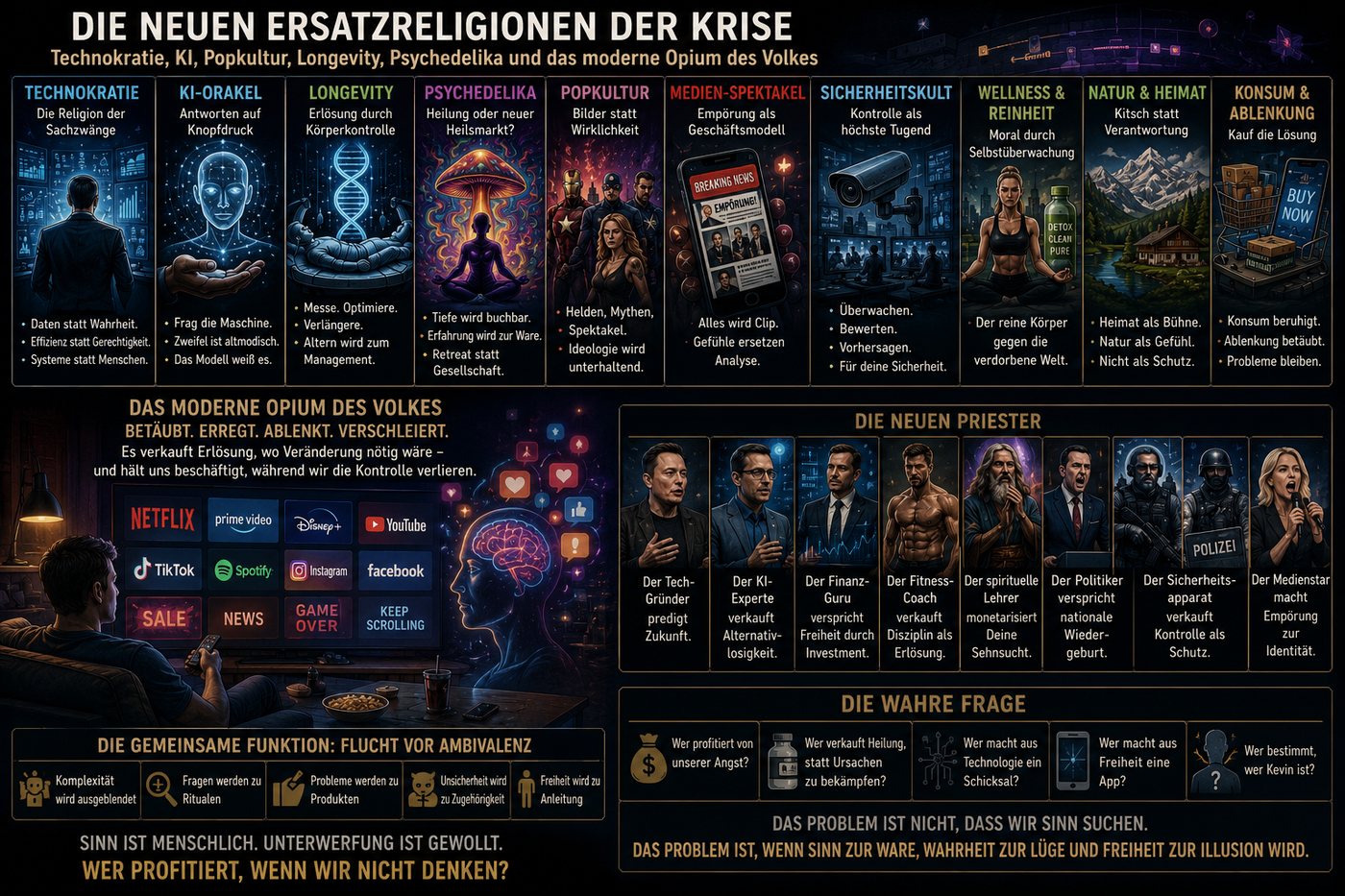
All these offers share one function: they redeem us from ambivalence. They turn questions into rituals, problems into products, politics into feelings, insecurity into belonging, freedom into instructions. And from that follows the real diagnosis: the present produces ever more problems that could be solved collectively — and sells ever more private redemptions to individuals. Climate crisis? Buy cooling. Loneliness? Buy coaching. Age? Buy longevity. Disorientation? Ask the AI. Society grows harder, but its anaesthetics come in ever softer packaging.
Homeland, heat, air conditioning
Climate change is no longer merely denied. It is being reinterpreted — and the air conditioner is the perfect symbol of it.
As long as climate policy stayed abstract, it could be sold as hysteria, green ideology, an attack on the ordinary person. Now the heat is arriving in flats. In schools. In care homes. In attic rooms. In bodies that can no longer sleep. Suddenly reality can no longer be talked away. So it is repackaged.
Not: we trivialised the climate crisis for too long. Not: we must cut emissions, rebuild cities, unseal soil, renovate buildings. But: we protect our people. Our homeland. Our families. And of course: we need air conditioning.
Air conditioning does solve a real problem in the short term, and nobody should deny cooling to the old, the sick or children in overheated flats. Protection from heat is not a luxury. But when air conditioners are sold as a substitute for climate policy, protection becomes a political excuse. The unspoken message then runs: we need not fundamentally question our urban planning, our energy policy, our soil sealing, our construction methods or our economic model. We will simply buy ourselves cool.
From„There is no climate change“
comes„We must protect our population from heat“
From„Climate policy is ideology“
comes„Air conditioning is plain common sense“
From„green panic“
comes„The state leaves our children sitting in hot classrooms“
The trick lies in acknowledging only the pain, never the cause.
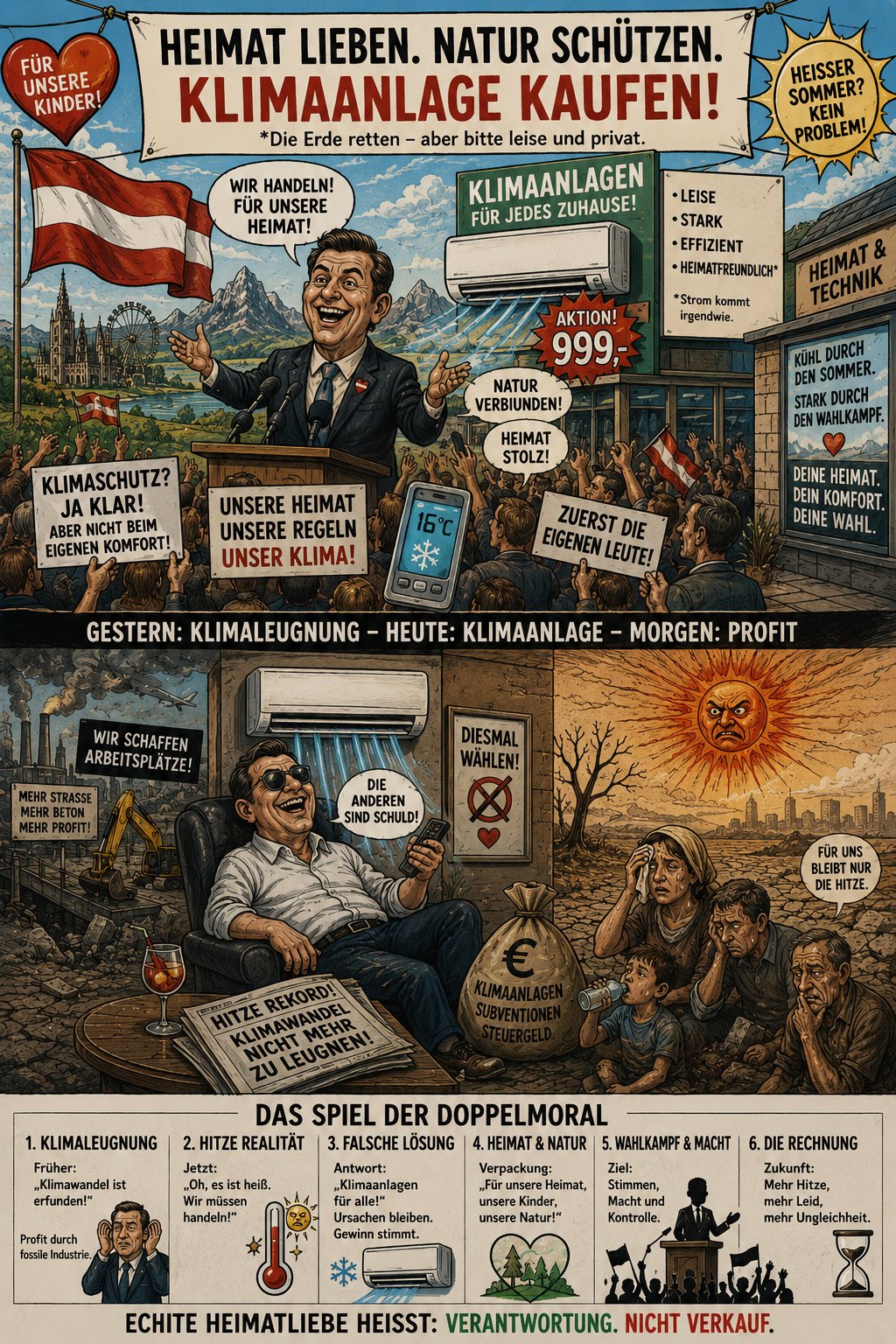
The pattern is that of someone who denies for years that the house is burning — and then sells fire extinguishers once the smoke reaches the bedroom. In France the same can be observed: the Rassemblement National, which long campaigned against climate policy, is discovering heat protection as a populist subject, and can thereby do several things at once — present itself as the protector of ordinary people, attack the government for poor preparation, and still avoid any serious climate policy. Politically shrewd. Intellectually cheap.
Cooling is a class question
Those with money cool down. The poor sweat. The affluent renovate, shade, plant, buy a split unit, drive to the countryside or work in an air-conditioned office. The poor sit in the badly insulated rented flat, in a densely built district, with little green and much asphalt. The old, children, the ill, those needing care and outdoor workers pay the bill first. Adaptation to climate change is therefore not a lifestyle question but social policy. Anyone demanding air conditioning while weakening the welfare state, public infrastructure and building renovation is promising cooling and delivering no justice.
And here an Austrian speciality shows itself. The Second Republic long told itself a story of antifascist success. That is not false, but it is incomplete: for decades the country's own Nazi entanglement was cushioned by the victim thesis, denazification remained limited, and former National Socialists were quickly reintegrated. Many wanted normality and reconstruction — even at the price of forgetting. That repressed history still works. It shows in the ability to package contradictions cosily: a little authoritarian, but not meant that way; a little völkisch, but only tradition; a little national, but only homeland; a little climate denial, but now an air conditioner after all. Say the hard thing softly and wrap the repressed thing in kitsch.
A real love of one's homeland would have to be radically sober today: if we want to protect these landscapes, these cities, these old people and these children, we must take the climate crisis seriously — not as a party symbol, not as panic, but as physical reality. Whoever says nature but mocks climate protection is lying. Whoever says homeland but seals the soil is lying. Whoever says children but lets schools overheat is lying. That is not the future. That is denial with a fan attached.
What actually helps
Not mockery. Mockery can expose, but it rarely frees.
Precision. One must distinguish between real causes and false culprits, between structural criticism and scapegoat thinking, between justified anger and paranoid projection. And one must name the inversion rather than treat every claim of victimhood as true: who actually holds power here? Who threatens whom? Who is demanding rights, and who is demanding submission?
Naming real problems. Far-right extremism, religious fundamentalism of every confession, nationalism of every origin, antisemitism, racism, misogyny, housing shortages and educational failure must not be passed over in silence for fear of the wrong applause. What matters is applying the same standard: whoever sees only the radicals of the other side is practising factional politics. And whoever ignores real discrimination strengthens the radicals' pose of victimhood.
A culture that allows for error. People must be able to admit mistakes without being socially destroyed — otherwise they cling to the lie. A democratic society needs the sentence: I was wrong, and I can still belong. Responsibility, yes, but without humiliation; those who are shamed flee into defiance.
Education that is not harmless. Not a poster campaign but basic democratic training: history, the mechanics of propaganda, media literacy, statistics, political economy, the rule of law, the capacity for conflict. And without blind spots — talk about fascism, but equally about religious fundamentalism in all its varieties, antisemitism, racism, ultranationalism, conspiracy belief, contempt for women and online radicalisation.
Social security. People in permanent fear of falling think worse; chronic stress makes them susceptible to simple explanations. In an era of technological upheaval, social security is not a brake but the precondition for people not fleeing into authoritarian substitute communities.
Democratic control of technology. The answer to AI cannot be hostility to technology. But AI must be treated as a question of infrastructure, not merely as a product: data, models, data centres and algorithmic decisions belong under regulation, and whoever deploys AI in work, administration, education, medicine or the welfare state must be accountable. Productivity gains must be distributed — otherwise AI becomes a machine for inequality.
Defending public space. A city may display diversity but must not accept intimidation: no leader cults, no banned symbols, no territorial markings. And: whoever fights nationalism must not fall back into ethnic thinking themselves.
Reclaiming citizenship — not in the stuffy sense but the republican one: people must learn again to be citizens, not merely consumers, followers, origin groups or carriers of rage.
The most dangerous form is the normal one
The most dangerous radicalisation is not the most spectacular. It is the one that becomes normal. When the leader kitsch stands on the shelf. When the flag permanently replaces thinking. When enemy images become everyday speech. When young men feel harder in symbols than in their own character. When every conflict is read as ethnic, national, religious or conspiratorial. When the citizen disappears and the follower returns.
Covid was loud, visible, hysterical. The present is more insidious: better adapted, more everyday, more widely distributed. It does not always wear a uniform. Sometimes it wears a ring, a hoodie, a tattoo, a party cap, a profile picture, a flag, a meme or a pose of victimhood. That is precisely why one must look more closely now.
History does not say: everything repeats itself exactly. It says: whoever ignores the early patterns will recognise the catastrophe only once it has already begun. Democracies die not only by coup. They also die by habituation. This republic has defences — institutions, a culture of remembrance, independent courts, civil society. But they do not work automatically. Democracy is not a machine that keeps running when nobody maintains it.
Vienna is not 1933. But Vienna is only Vienna as long as it remains a republic: free, plural, governed by law, self-assured — and unimpressed by every nationalism and every claim to absolute truth, whatever flag it carries and in whosever name it appears.
Freedom does not begin where everyone wears the same sign. It begins where people can disagree without fear